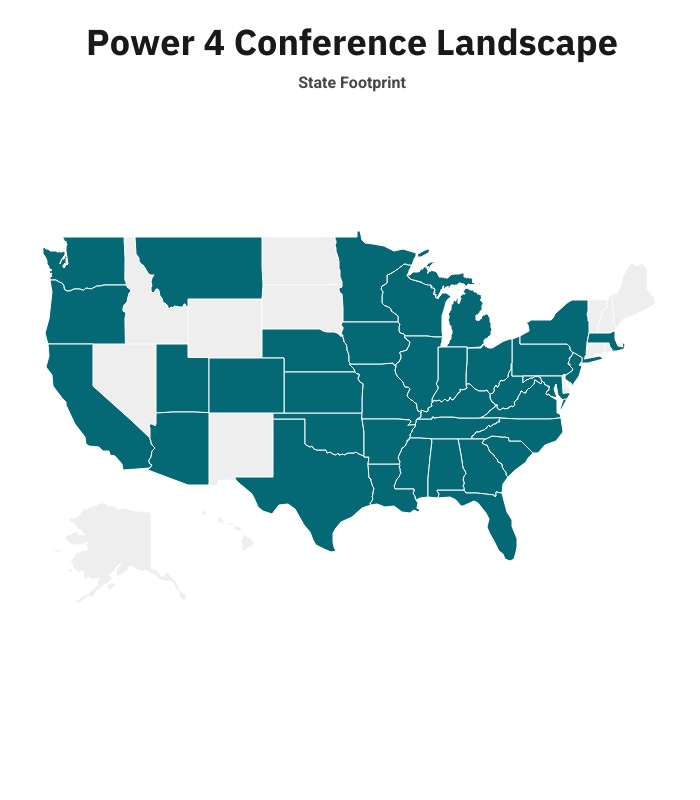
It is the year 2026 and College Football has evolved/devolved into economic trench warfare. The major power players range from your local used car salesman booster all the way up to the U.S. Congress. But the main movers and shakers in the evolving CFB landscape are the sport’s Power 4 conferences: Atlantic Coast Conference (ACC), Big 12, Big Ten and the Southeastern Conference (SEC).
Big Ten
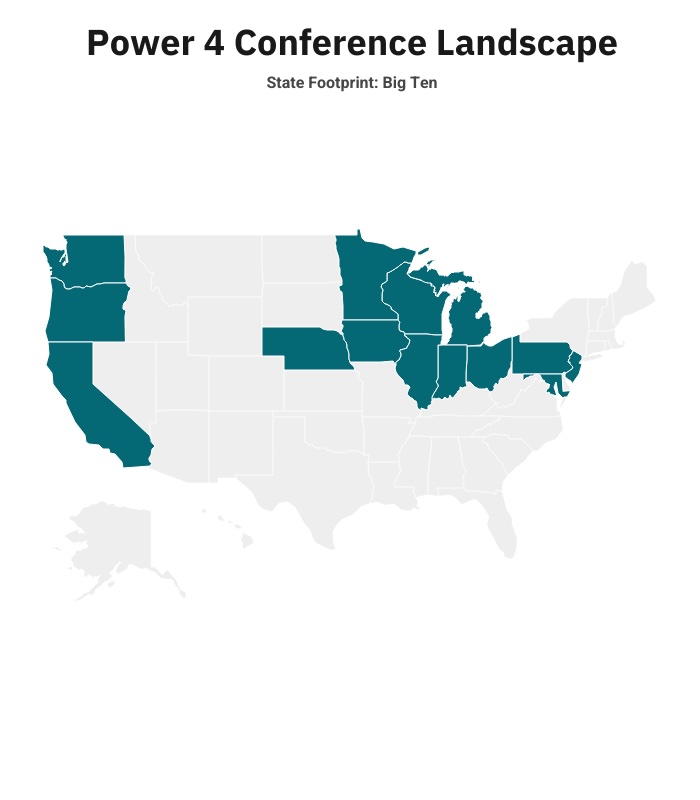
The Big Ten is currently the largest conference in terms of membership with 18 programs heading into the 2026-27 CFB season. The conference’s programs are spread across 14 states, primarily in the country’ Midwest region. But in recent years the Big Ten has folded in four West Coast programs after the Pac-12 conference went underwater. Two of those programs are located in the state of California (UCLA and USC) and the University of Oregon and the University of Washington were also included in the transition. The conference has longer tenured members who are located in the Northeast, the University of Maryland and Rutgers in New Jersey.
| State | School |
| California | UCLA |
| USC | |
| Illinois | Illinois |
| Northwestern | |
| Iowa | Iowa |
| Maryland | Maryland |
| Michigan | Michigan |
| Michigan State | |
| Minnesota | Minnesota |
| Nebraska | Nebraska |
| New Jersey | Rutgers |
| Ohio | Ohio State |
| Oregon | Oregon |
| Pennsylvania | Penn State |
| Washington | Washington |
| Wisconsin | Wisconsin |
ACC
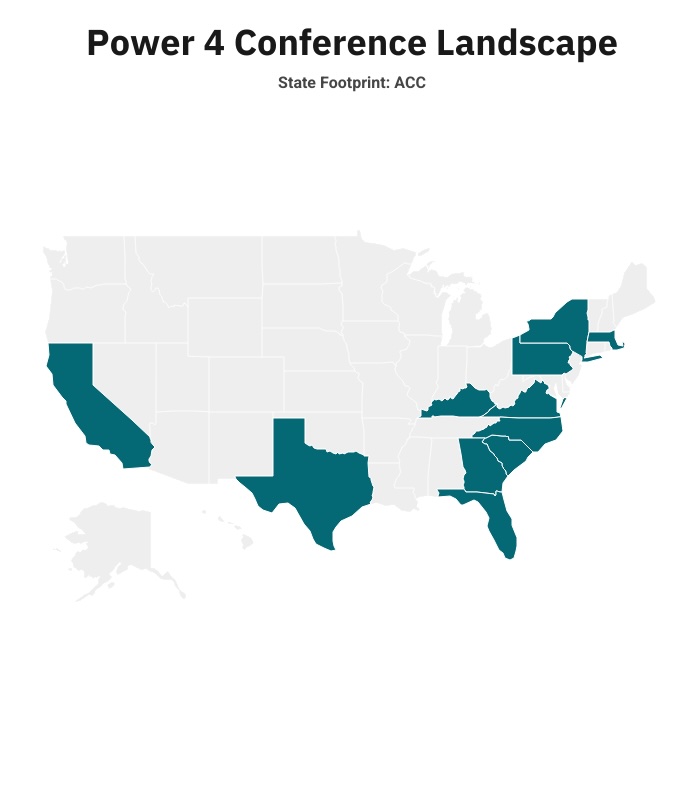
The ACC ranks number two in terms of conference membership, with 17 active members. The member programs are spread across 14 states that are concentrated along America’s East Coast. The ACC recently absorbed two programs from the state of California (California and Stanford). Texas’ Southern Methodist University also recently made its jump back to the Power 4 and is now in the ACC.
| State | School |
| California | California |
| Stanford | |
| Florida | Florida State |
| Miami (FL) | |
| Georgia | Georgia Tech |
| Kentucky | Lousiville |
| Massachusetts | Boston College |
| New York | Syracuse |
| North Carolina | Duke |
| North Carolina | |
| North Carolina State | |
| Wake Forest | |
| Pennsylvania | Pitt |
| South Carolina | Clemson |
| Texas | SMU |
| Virginia | Virginia |
| Virginia Tech |
Big 12
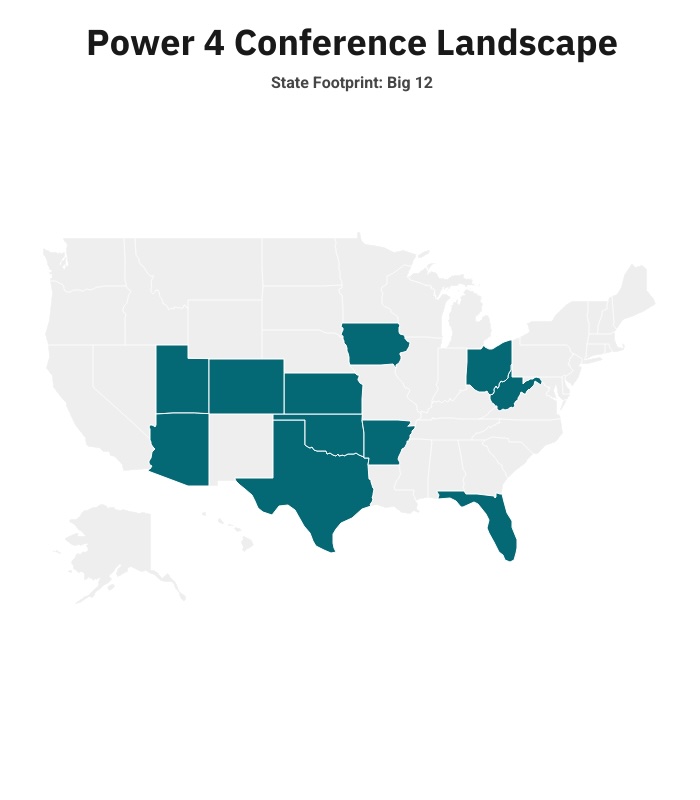
The Big 12 conference has the smallest state footprint among CFB’s Power 4 conferences. Its 16 programs are spread across ten states. The Pac-12’s dissolution sent four programs from the West Coast into the Big 12. The University of Arizona and Arizona State made the jump along with the University of Colorado and the University of Utah. The conference has a few other geographic outliers, the University of Central Florida, the University of Cincinnati and the University of West Virginia.
| State | School |
| Arizona | Arizona |
| Arizona State | |
| Colorado | Colorado |
| Florida | UCF |
| Iowa | Iowa State |
| Kansas | Kansas |
| Kansas State | |
| Ohio | Cincinnati |
| Oklahoma | Oklahoma State |
| Texas | Baylor |
| Houston | |
| TCU | |
| Texas Tech | |
| Utah | BYU |
| Utah | |
| West Virginia | West Virginia |
SEC
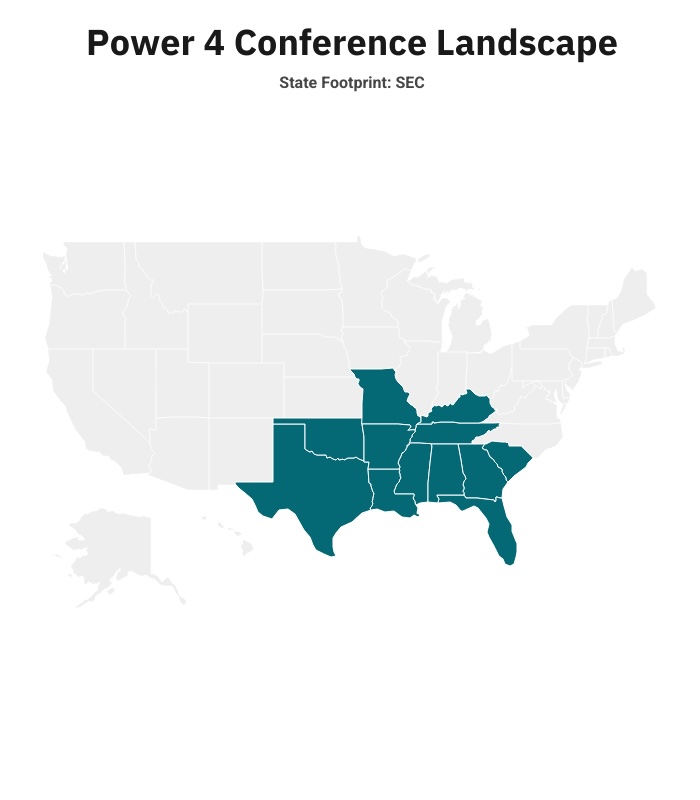
The SEC’s 16 member programs are located in 12 different states. All of the states are located in the country’s South. Missouri is the northernmost state, Texas represents the western limit, Florida is the southernmost tip and South Carolina is the most eastward state.
| State | School |
| Alabama | Alabama |
| Auburn | |
| Arkansas | Arkansas |
| Florida | Florida |
| Georgia | Georgia |
| Kentucky | Kentucky |
| Louisiana | LSU |
| Mississippi | Mississippi State |
| Ole Miss | |
| Missouri | Missouri |
| Oklahoma | Oklahoma |
| South Carolina | South Carolina |
| Tennessee | Tennessee |
| Vanderbilt | |
| Texas | Texas |
| Texas A&M |
Historically, the state that a college football program’s home state could tell a lot about where they sat in the hierarchy as well as what their ceiling might be. But in the current economic war of attrition, the strength and nuances of local economies are likely going to play a much larger role in determining the fate of Power 4 CFB programs.