Historically, the state that a college football program’s home state could tell a lot about where they sat in the hierarchy as well as what their ceiling might be. But in the current economic war of attrition, the strength and nuances of local economies are likely going to play a much larger role in determining the fate of Power 4 CFB programs.
Big Picture
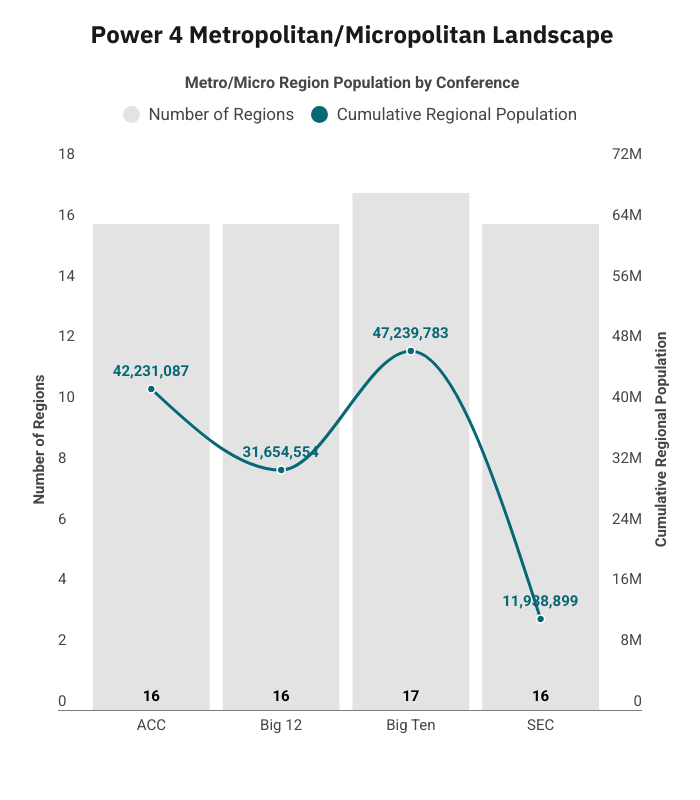
College Football’s Power 4 programs are located in 64 of America’s metropolitan and/or micropolitan areas. Sixty-four of the institution’s host areas are considered metropolitan and three of the areas are smaller, micropolitan regions.
| Conference | Metropolitan | Micropolitan |
| Big Ten | 17 | 0 |
| ACC | 16 | 0 |
| Big 12 | 15 | 1 |
| SEC | 14 | 2 |
All 18 of the Big Ten’s CFB programs are located in a metropolitan area. The ACC has fewer member programs but like the Big Ten, all of them are located in metropolitan areas.
The Big 12 and SEC are the only Power 4 conferences that have members located in micropolitan areas.
Big Ten
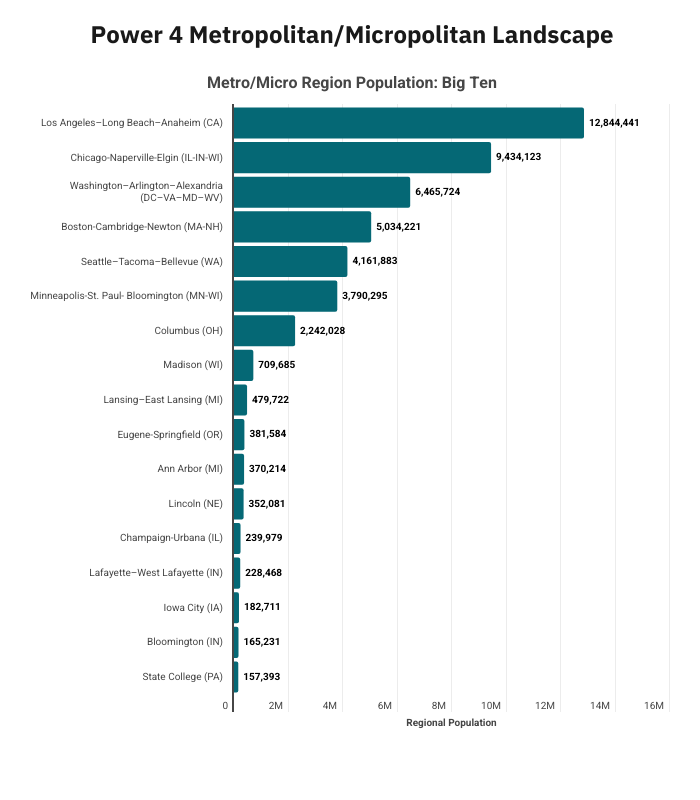
The expected population of the Big Ten’s metropolitan areas is 47,239,738 residents. Seven of the conference metropolitan areas have more than 1,000,000 residents. UCLA and USC are both located in the Los Angeles-Long Beach-Anaheim metro area, with 12,844,441 residents. Ohio State is located in the Columbus, OH metro area which has 2,242,028 residents. Penn State is located in State College, the Big Ten’s smallest metro area, with 157,393 residents.
| School | Region | Population |
| Michigan | Ann Arbor | 370,214 |
| Indiana | Bloomington | 165,231 |
| Rutgers | Boston-Cambridge-Newton, MA-NH | 5,034,221 |
| Illinois | Champaign-Urbana | 239,979 |
| Northwestern | Chicago-Naperville-Elgin, IL-IN-WI | 9,434,123 |
| Ohio State | Columbus, OH | 2,242,028 |
| Oregon | Eugene-Springfield | 381,584 |
| Iowa | Iowa City | 182,711 |
| Purdue | Lafayette–West Lafayette | 228,468 |
| Michigan State | Lansing–East Lansing | 479,722 |
| Nebraska | Lincoln | 352,081 |
| Wisconsin | Madison | 709,685 |
| Minnesota | Minneapolis-St. Paul- Bloomington, MN-WI | 3,790,295 |
| Washington | Seattle–Tacoma–Bellevue | 4,161,883 |
| Penn State | State College | 157,393 |
| Maryland | Washington–Arlington–Alexandria, DC–VA–MD–WV | 6,465,724 |
| Region | Population | School |
| Los Angeles–Long Beach–Anaheim | 12,844,441 | UCLA |
| USC |
ACC
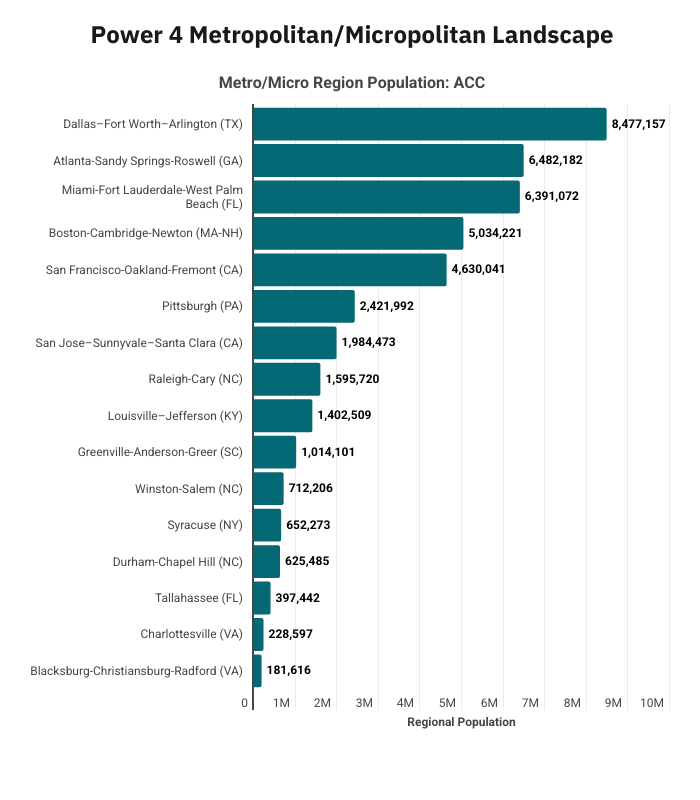
The estimated population for the ACC’s metropolitan areas is 42,231,087. While the conference’s overall population is slightly smaller than the Big Ten, the ACC’s spread of larger metro areas is greater. Ten of the programs are located in metro areas with 1,000,000 or more residents, compared with seven for the Big Ten. Recent addition SMU is located in the largest metro area. The Dallas-Fort Worth-Arlington metro area’s estimated population is 8,477,157. Other major metro areas include Miami-Fort Lauderdale-West Palm Beach, Atlanta-Sandy Springs-Roswell, Boston-Cambridge-Newton (MA-NH), and San Francisco-Oakland-Fremont. The ACC’s two smallest metro areas are located in Virginia. The University of Virginia sits in the Charlottesville metro area which has a population of 228,597. Virginia Tech is located in the Blacksburg-Christiansburg-Radford metro area which has a population of 181,616 residents.
| School | Region | Population |
| Georgia Tech | Atlanta-Sandy Springs-Roswell | 6,482,182 |
| Virginia Tech | Blacksburg-Christiansburg-Radford | 181,616 |
| Boston College | Boston-Cambridge-Newton, MA-NH | 5,034,221 |
| Virginia | Charlottesville | 228,597 |
| SMU | Dallas–Fort Worth–Arlington | 8,477,157 |
| Clemson | Greenville-Anderson-Greer | 1,014,101 |
| Louisville | Louisville–Jefferson | 1,402,509 |
| Miami (FL) | Miami-Fort Lauderdale-West Palm Beach | 6,391,072 |
| Pitt | Pittsburgh | 2,421,992 |
| North Carolina State | Raleigh-Cary | 1,595,720 |
| California | San Francisco-Oakland-Fremont | 4,630,041 |
| Stanford | San Jose–Sunnyvale–Santa Clara | 1,984,473 |
| Syracuse | Syracuse | 652,273 |
| Florida State | Tallahassee | 397,442 |
| Wake Forest | Winston-Salem | 712,206 |
Big 12
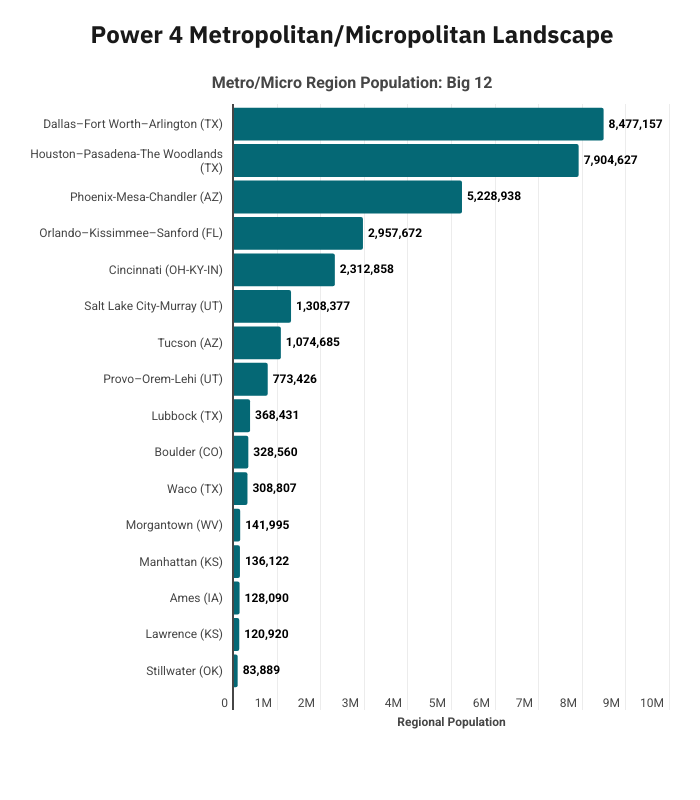
The estimated population for the Big 12’s metropolitan areas is 31,654,554. Seven of the conference’s members are located in metro areas with more than a million residents. Similar to the ACC, the Dallas-Fort Worth-Arlington metro area is the largest in the conference. Longtime Big 12 member TCU sits to the west of SMU on the Fort Worth side of the Metroplex. The University of Arizona is located in the Tucson metro area, which has an estimated population of 1,074,685. The Big 12’s smallest home region is a micropolitan area. Oklahoma State University is located in the Stillwater micro area, which has a population of 83,889.
| School | Region | Population |
| Iowa State | Ames | 128,090 |
| Colorado | Boulder | 328,560 |
| Cincinnati | Cincinnati, OH-KY-IN | 2,312,858 |
| TCU | Dallas–Fort Worth–Arlington | 8,477,157 |
| Houston | Houston–Pasadena-The Woodlands | 7,904,627 |
| Kansas | Lawrence | 120,920 |
| Texas Tech | Lubbock | 368,431 |
| Kansas State | Manhattan | 136,122 |
| West Virginia | Morgantown | 141,995 |
| UCF | Orlando–Kissimmee–Sanford | 2,957,672 |
| Arizona State | Phoenix-Mesa-Chandler | 5,228,938 |
| BYU | Provo–Orem-Lehi | 773,426 |
| Utah | Salt Lake City-Murray | 1,308,377 |
| Oklahoma State | Stillwater | 83,889 |
| Arizona | Tucson | 1,074,685 |
| Baylor | Waco | 308,807 |
SEC
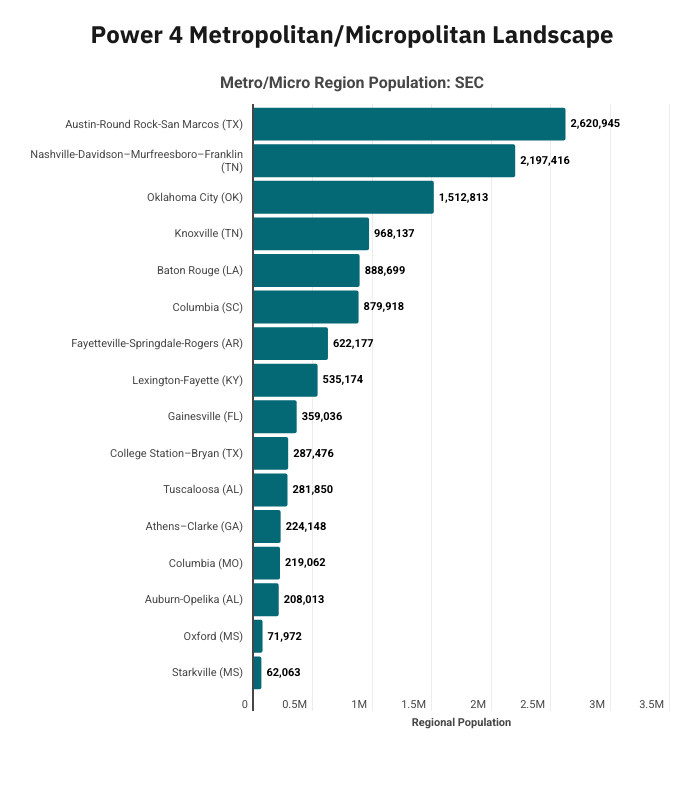
The estimated population for the SEC’s metropolitan areas is 11,938,899. Three of the conference’s members are located in a metro area with 1,000,000 or more residents. The University of Texas sits in the largest metro area, Austin-Round Rock-San Marcos, which has an estimated population of 2,620,945.The Nashville-Davidson-Murfreesboro-Franklin metro area is Vanderbilt University’s home and the area has 2,197,416 residents. The University of Oklahoma sits in the Oklahoma City metro area which has an estimated 1,512,813 residents.
Both of the SEC’s CFB programs are located in micropolitan areas. Ole Miss sits in Mississippi’s Oxford micropolitan area which has an estimated 71,972 residents. Mississippi State University is located in the Starkville micropolitan area which has a population of 62,063.
| School | Region | Population |
| Georgia | Athens–Clarke | 224,148 |
| Auburn | Auburn-Opelika | 208,013 |
| Texas | Austin-Round Rock-San Marcos | 2,620,945 |
| LSU | Baton Rouge | 888,699 |
| Texas A&M | College Station–Bryan | 287,476 |
| Missouri | Columbia, MO | 219,062 |
| South Carolina | Columbia, SC | 879,918 |
| Arkansas | Fayetteville-Springdale-Rogers | 622,177 |
| Florida | Gainesville | 359,036 |
| Tennessee | Knoxville | 968,137 |
| Kentucky | Lexington-Fayette | 535,174 |
| Vanderbilt | Nashville-Davidson–Murfreesboro–Franklin | 2,197,416 |
| Oklahoma | Oklahoma City | 1,512,813 |
| Ole Miss | Oxford | 71,972 |
| Mississippi State | Starkville | 62,063 |
| Alabama | Tuscaloosa | 281,850 |
The Big Three
Three of the country’s metropolitan areas are home to multiple Power 4 college football programs. The Los Angeles–Long Beach–Anaheim metro area has close to 13 million residents and UCLA and USC both sit within its bounds. The ACC’s SMU and the Big 12’s TCU are both located in the Dallas–Fort Worth–Arlington metro area which has a population of close to 8.5 million. The Boston-Cambridge-Newton, MA-NH area has close to 5 million residents. Boston College from the ACC and Rutgers University from the Big Ten share the Boston metro area.